
“The Minnesota Timberwolves have morphed into the most tortured franchise in professional basketball. Unlike the Clippers (a perennial laughingstock until recently), the Suns (a classic came-oh-so-close team), the Cavaliers (not even the second-most tortured franchise in their own city) and Kings (historical nomads), the Wolves lack an identity beyond the whole “they suck every year, they always screw up, but at least they have great fans” tag. Doesn’t that really mean that their fans are just loyal saps? What keeps them coming back? At what point do you just throw your hands up and scream, “ENOUGH”?
Bill Simmons wrote those words for his old Grantland site back in March 2012.
Okay, I lied.
Not about Simmons actually writing. (Eds note: Younger readers, Bill Simmons was a writer before he turned to full-time podcasting.)
I lied about the team he was describing. The expanded excerpt actually reads:
“You might not know this, you might not believe it … but once upon a time, the Golden State Warriors won the NBA championship.
The big day happened in the spring of 1975, well before things like cable TV, DirecTV, computers, video games, iPads, iPods, CDs, DVDs, Blu-rays, e-mails and the Internet. They swept Washington in the Finals thanks to a transcendent effort from Rick Barry, one of the best 25 players of all time and the finest passing forward of his generation. The following spring, the heavily favored Warriors blew their chance to repeat because Barry fought Phoenix’s Ricky Sobers in the first half of Game 7 of the Western Finals, bristled when his teammates didn’t defend him, then refused to shoot for the next hour.
And so it began. Three and a half decades later, the Golden State Warriors have morphed into the most tortured franchise in professional basketball. Unlike the Clippers (a perennial laughingstock until recently), the Suns (a classic came-oh-so-close team), the Cavaliers (not even the second-most tortured franchise in their own city) and Kings (historical nomads), the Warriors lack an identity beyond the whole “they suck every year, they always screw up, but at least they have great fans” tag. Doesn’t that really mean that their fans are just loyal saps? What keeps them coming back? At what point do you just throw your hands up and scream, “ENOUGH”?
After they booed current owner Joe Lacob during Chris Mullin Night on Monday — and booed, and kept booing, and booed some more, and even kept booing after Mullin and Barry begged them to stop — to casual observers, it seemed like an especially mean-spirited act by an especially mean-spirited group of fans. It’s a little more complicated than that. You can’t blame people for failing to act sane after they’ve been already driven insane. Here’s how the Warriors drove their fans crazy in 60 steps.”
It seems hard to believe now, 13 years later, that what has become the premier NBA franchise of the century was once described as one of the worst. It’s even wilder to consider those words being written three years after they drafted Steph Curry, the eventual franchise savior and all-time great.
Pro sports franchises lack some of the personal bonds to fans that college or especially high school teams do. People pay money to watch top talent, and the players tend to become as much characters in a story as anything. But one thing pro teams all have is a history, and it’s one that is shared and interconnected to the other teams in the league.
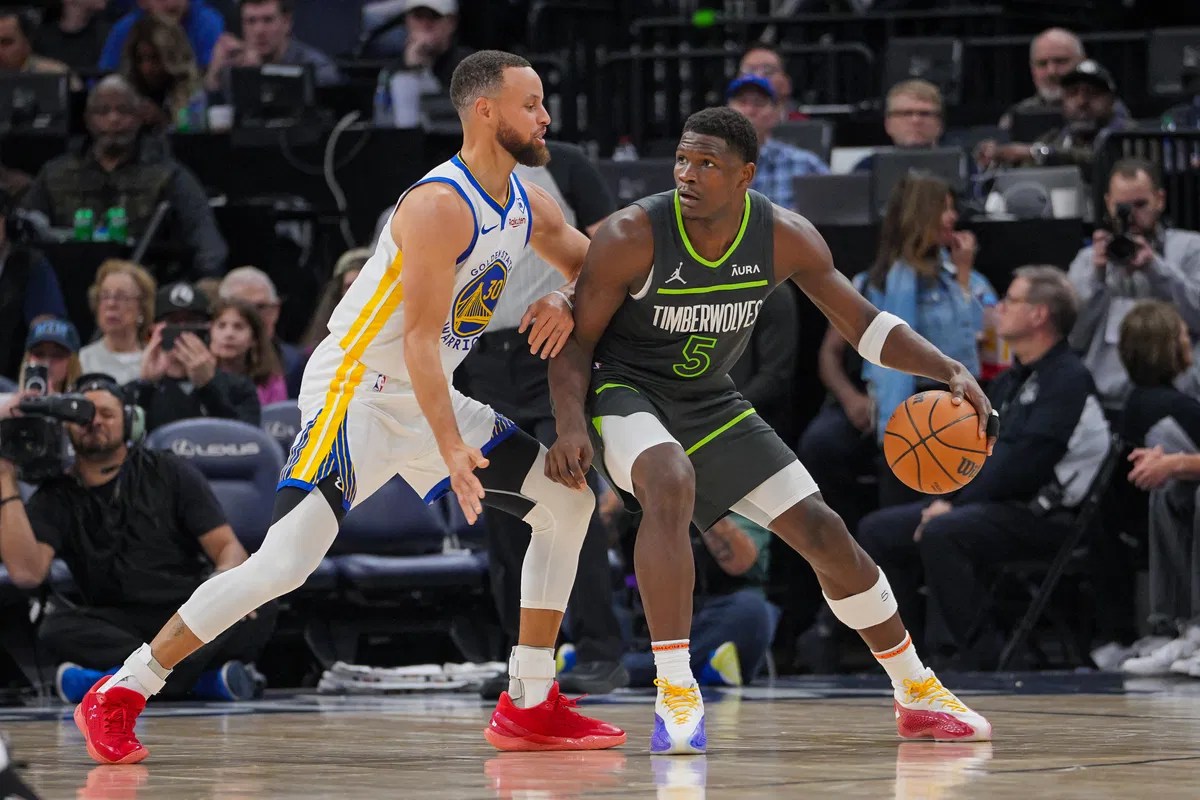
As the Wolves and Warriors set to launch their first postseason matchup ever, I found a whole bunch of strands, intersections, transactions, and “what if’s” that help define their relationship as competitor franchises in the NBA’s Western Conference, dating back to the Timberwolves franchise inception, in 1989.
What follows is that list, not in chronological order, but loosely in order of significance for each team.
Rick Adelman coached both teams to failure.
Rick Adelman is a Hall of Fame coach. He went to the Finals twice with Portland, and should’ve won a ring with Sacramento. He won a whole bunch in Houston, too.
Much, much less successful were his relatively brief stints in Golden State in the mid-90s, and finishing off his career in Minnesota, in the early 2010s.

It’s hard to lose more games than you win with Rick Adelman on your bench, but each of these franchises managed to do just that.
Jim Pete!
Wolves longtime color commentator Jim Petersen played the final 3 seasons of his NBA career as a Golden State Warrior.
Both teams were unhealthily invested in Joe Smith
The Warriors did this:

The Timberwolves did this:

The Highs & Lows of The Latrell Sprewell Experience
Spree played his prime seasons in Golden State under Don Nelson. He made three All-Star Teams and an All-NBA 1st Team, as a Warrior. His highlight reel from those days is something to spend some time Googling and admiring. Unfortunately, he is broadly remembered not for those accolades, but for choking P.J. Carlisimo in one of the biggest player-coach confrontations in American sports history.
After a good run in New York that included a trip to the Finals, Spree came to Minnesota. Along with KG and Sam Cassell, he helped lead the team to its first successful playoff run in history. Unfortunately again, things ended on unfortunate terms. He turned down what was reportedly a 3-year $21 Million contract extension offered by Glen Taylor, infamously telling the local press that he has a “family to feed.” The quote gets repeated on local radio airwaves, to this day. He turned in one more season as an unhappy Timberwolf, a big dropoff in fun and success from ’04, and never again found employment in the NBA.
The 1st and 2nd Picks in the 2020 Draft
This isn’t quite so interesting because the team choosing first chose correctly. But it’s worth briefly acknowledging, because all of Wolves history suggests they would choose incorrectly in this situation, but they got this one right. They took Ant over James Wiseman and LaMelo Ball. Golden State, choosing second, chose Wiseman, who became a bust.
In the lead-up to that draft, there was no consensus on the best player. Many liked Edwards. Many liked Wiseman. Many liked Ball. Many didn’t really like the draft at all, and likely would have explored trade-down opportunities. Had Golden State identified Edwards as the Antman he would later become, I strongly suspect that they could’ve gotten him for a medium premium, trading up from 2 to 1.
Jimmy Butler
This one is an unfinished book on the GSW end of it. We know how the story always begins, and we know how it seems to always end: Jimmy has success, everyone loves Jimmy, Jimmy gets tired of situation, Jimmy ruins situation.
We got the full (premium?) Jimmy Experience in the span of one calendar year, Summer 2017 to 2018. He showed up, he brought winning basketball with him, he soon decided that he wanted out, he completely disregarded his contractual obligation to show up for work like a professional (or even hokier concepts like being a decent teammate), and he left a giant pile of ashes in his wake on the first available flight to South Beach.
The Warriors got Jimmy late in the season, perhaps wisely gambling on the (enormous) talent bump as a turbo booster to push Steph and Draymond on their last meaningful legs. They’ve played great basketball with Butler, and will present a big challenge to the Wolves in this series.
How it ultimately ends for Butler and the Warriors is a different matter altogether, however, and Dubs Nation can ask Bulls, Wolves, Sixers, or Heat fans how it normally goes.
Jimmy versus Target Center Crowd is a high-leverage factor in the upcoming series.
Draymond Green resents Rudy Gobert’s Defensive Player of the Year awards and sometimes physically assaults him because of said resentment.
Draymond and Rudy have been two of the very best defensive players of this century. The people who vote for the DPOY award have seemed to favor Gobert over Draymond, for whatever reason. Most of this was when Rudy was in Utah, leaving me outside of the people on the internet who even realize anyone cared much about it. Draymond has lashed out about this many times, and eventually just put Rudy in a sleeper chokehold in the middle of a game, last year. Odd stuff.
I’m sure the story will evolve over the next couple weeks.
Donyell Marshall for Tom Gugliotta
As some of the info above should make clear, the mid-90s Warriors were a mess. One of their many mistakes of that timeframe was quickly giving up on Tom Gugliotta (their chief return on the franchise-shattering Chris Webber trade debacle) and flipping him for the Wolves disappointing rookie forward, Donyell Marshall.
Where Marshall generally continued to struggle in Golden State, “Googs” became the first All-Star player in Wolves franchise history. Marshall eventually found his footing around the league as a journeyman role player, but never approximated Googs’s value as an all-around player. The Wolves drafted KG shortly after this trade, and soon began a long stretch of playoff appearances.
Andrew Wiggins and a barely-protected future 1st Round Pick for D’Angelo Russell
I’m sure that Gersson Rosas would say that his Timberwolves tenure is defined by the 2020 Draft, when he netted both Anthony Edwards and Jaden McDaniels. I’d say that if I were him, anyway.
But in terms of flexing executive power, nothing would match his February 2020 trade of Andrew Wiggins and a top-3 (!) protected future first, for D’Angelo Russell.
The Warriors obviously “won” this trade, because they won the 2022 NBA Championship with Wiggins serving as their second-best player in the Finals. Meanwhile, the shine came off of D’Lo pretty quickly. The Wolves eventually started to win some games after hiring Chris Finch and drafting Edwards, but it usually felt like winning in spite of D’Lo. Finch famously benched him in crunchtime of an elimination Game 6 versus Memphis, and not a single Wolves fan objected.
There are some ongoing developments of this trade, however, as well as some noteworthy externalities. The ongoing development is that the very-high draft pick sent to Golden State became Jonathan Kuminga. Right now, a healthy JK can barely get off of Steve Kerr’s bench in these playoffs. It is possible that the Wolves did not miss out on much, there. (One could argue, as I have, that we still could’ve drafted Franz Wagner, who was taken 8th, one spot after Kuminga.) The externalities are that the trade, paired with other Rosas moves (losing Tyus and Saric for nothing, hiring unready Saunders as coach, among others) made the team so bad that they won the lottery in 2020, falling into Ant. Furthermore, after Tim Connelly took over POBO duties, he was able to flip D’Lo for Mike Conley, Nickeil Alexander-Walker, and draft equity, in what Britt Robson has dubbed the best trade in franchise history.
That trade of high-salaried, inconsistent, high-profile players was rather significant for each team, and continues to evolve with time.
Drafting the Wrong Point Guard
Not that one!
Well, not yet anyway. We’re not there yet.
Long before 2009 was 1989, when the Wolves first participated in an NBA Draft. League owners allowed the expansion teams (Wolves and Magic) the 10th and 11th picks. The Wolves won the coin clip for 10, and with it selected Pooh Richardson, point guard from UCLA.
The pick was a mild surprise to all, as Pooh wasn’t projected to go quite that high. In the first of countless mistakes, the Wolves whiffed on a handful of All-Stars taken immediately after him. Most notable when you factor in the position of preference, the pre-draft hype of the player, and the Hall of Fame career that followed, was Tim Hardaway, chosen 14th by — you guessed it — the Golden State Warriors.
The UTEP Two-Step became a central figure in “Run TMC,” and some very good Warriors teams. (Before the mid-90s implosion, of which Hardaway was a part, to be clear.) But if Hardaway comes to Minnesota and thrives, maybe the obsessive winner Bill Musselman has enough self-preservation instincts to keep his job, and who knows what else happens. It’s a pretty big “What if?” among many, in Wolves history, and it weaves right into Warriors history as well.
The Trade that Almost Was
When Kevin Love announced that he would not be re-signing with the Wolves and preferred to be traded, attention quickly turned to Golden State; specifically, to Klay Thompson.
The story is told in slightly different ways, but what generally seems to be true is that the Wolves wanted Klay Thompson as the primary return piece in the deal, some within the Warriors organization wanted to pull the trigger for K-Love — at the time, a statistical monster who would go onto a lesser role amid championship success in Cleveland — but the deal was nixed after a series of intense meetings. Most notably among the objectors was the late Jerry West, then a Warriors consultant.
Had West not intervened and the deal had gone through, the last 11 years of each franchise’s history would’ve been entirely different. No Splash Brothers and probably no titles in Golden State. No Andrew Wiggins and almost certainly no Karl-Anthony Towns in Minnesota.
Okay, fine. We can talk about Steph Curry.
The most consequential decisions in the history of the Minnesota Timberwolves and Golden State Warriors happened in the early evening hours of June 25, 2009. Since you already know what those decisions were, however, I’d instead like to take the time machine farther back, all the way to June 27, 1990.
Nineteen drafts earlier, the Wolves were picking twice in the first round. Unfortunately for them and their early building efforts, talent was hard to come by that year. They took Felton Spencer 6th in a move that was not exciting but also not really a mistake. They didn’t miss out on anything special and Spencer played a number of years in the league as a decent role-player center. Their second first-rounder, 20th overall, was scoring guard Gerald Glass, from Ole Miss. Glass would go on to become synonymous with Why Bill Musselman Got Fired. He could score, but couldn’t do much else, and fans and local media seemed to prefer the tantalizing upside of a rookie scorer to the likes of Scott Brooks and Tony Campbell, veterans of the minor league CBA who were never, ever going to carry an NBA franchise to anywhere special.
What does this have to do with Steph Curry, you’re wondering. Allow me to clip from Sid Hartman’s column from June 29, 1990, two days after the draft:

Dell Curry, one of the league’s early prolific three-point shooting specialists, went on to play 8 more seasons in Charlotte after almost being traded to Minnesota. On that fateful night in 1990, he had a 2-year old son Stephen, who would go on to be raised in Charlotte before attending Davidson College, nearby.
One part of the story of why the Wolves decided to draft two consecutive point guards Not Named Stephen Curry in 2009 was that Curry refused them a predraft workout and that his family made it clear he did not want to play there. This subject was revisited in a piece for The Athletic by Jon Krawczynski, Zach Harper, and Marcus Thompson.
For a relatively minor potential trade — the 20th pick in a bad draft for a shooting specialist like Dell Curry — the implications of it are far reaching, and certainly extend to the 2009 draft, 19 years later. The immediate effects would mean Musselman had a viable off guard (a subject he complained about publicly in his simmering feud with then player personnel director, Billy McKinney) and — more importantly, perhaps — did not have his Gerald Glass Problem that helped cost him his job. Any alternate history that involves Continued Musselman Employment is a major one for re-directing the ensuing seasons, which were among the worst in franchise history. (Yes that’s saying a lot. Yes it’s also true.)
But of course where I am going with this is less about 1991 or 1992, and more about 2009. If Steph Curry grows up a Timberwolves fan in Wayzata instead of a Hornets fan in Charlotte, maybe if the Wolves stink in 2009 and have the chance to draft him, it’s a more natural fit.
Of course there’s no way of knowing, but it’s one example of many here, where you see the potential ripple effects from one thing that was or was not done.
Tuesday night the Wolves and Warriors continue their shared history in what promises to be an intriguing second round matchup. The Wolves are now in their fourth consecutive postseason, and second consecutive second-round appearance. They have a long ways to go before they might consider themselves on the Warriors level as a successful franchise. But it’s comforting to look back with a longer view to see what these teams and their fan bases have in common.
In his Grandland piece, Simmons seems to suggest that the Warriors loyal fan base was not actually great, but maybe “saps.” As if they should be holding public protests instead of paying for tickets? I guess that’s the perspective of a Celtics/Patriots/Red Sox homer, in the Year 2012. There are certainly Golden State fans of a certain relatively young age that only know championship expectations and have a very distorted understanding of what this exercise of NBA fandom can look like. But I bet most of their longer-time faithful still remember the other side of it; the side that screws up the draft pick or signs the illegal contract and gets busted. It’s the same side that has a one star player demand a trade after winning Rookie of the Year, while another chokes the new coach in practice.
History will keep evolving this week.
Go Wolves.